A 5-Year Cost Comparison: Veneer vs Solid Wood Coffee Tables in Singapore
Choosing a coffee table for a Singapore home is rarely just a choice between two finishes. A veneer coffee table may use a thinner, engineered panel with a real wood surface, while a solid wood coffee table is cut from timber throughout. Their purchase prices can look similar, yet their costs over 5 years can diverge because of movement, repairs, finishes and replacement cycles.
This comparison uses realistic Singapore figures in SGD, including 7% GST where shown. It considers HDB flats in Tampines, Bedok and Punggol, as well as condos where narrow corridors and compact lifts affect delivery planning. For a 120 × 60 × 40 cm coffee table, I have modelled a mid-market veneer option at S$460 before GST and a solid oak option at S$790 before GST.
The figures are planning estimates rather than quotations. Timber grades, widths, finishes and hardware change prices, and every building has different access rules. The aim is to show what a buyer might actually spend across 60 months, not to reduce furniture ownership to one number.
What exactly are we comparing over 60 months?
A coffee table sg listing can describe several constructions without making their cost implications obvious. In this comparison, “veneer” means a 18–25 mm engineered wood panel finished with 0.6–1.2 mm real wood veneer. The core may be MDF, plywood or particleboard. The visible face is wood, but the panel is not solid throughout.
The solid option is a 120 × 60 × 40 cm table made from kiln-dried oak or a comparable hardwood, with a minimum top thickness of 25 mm. It may have mortise-and-tenon joinery, dowels or sturdy mechanical fixings. Veneer tables commonly use concealed screws, staples or cam fittings because engineered cores move differently from solid timber.
Over 5 years, I count the table cost, 8% GST, local delivery, assembly, expected finish maintenance, one repair visit and a replacement reserve. I do not count electricity, insurance or personal time. A condominium owner may also need to reserve S$120 for a longer carrying path, although many lifts accept a flat-packed table and avoid extra charges.
| Item | Veneer example | Solid wood example |
|---|---|---|
| Table, before GST | S$460 | S$790 |
| 8% GST allocation | S$36.80 | S$63.20 |
| Delivery and assembly | S$60 | S$80 |
| 5-year maintenance allowance | S$90 | S$60 |
| Repair-risk allowance | S$110 | S$70 |
| Monthly replacement reserve | S$11.67 | S$16.67 |
The reserves are deliberately modest. They do not assume a disaster. They reflect ordinary Singapore humidity, cleaning, small scratches and the possibility of one component needing service during 60 months.
How much does each table cost in year one?
The veneer example totals about S$656.80 in year one after its allowances are included: S$460 for the table, S$36.80 for GST, S$60 for delivery and assembly, S$90 for maintenance and S$110 for repair risk. The solid wood example totals S$1,063.20 in the same period. That is roughly S$406.40 more at the start.
Local delivery is not a trivial part of the decision. A 120 × 60 × 40 cm table weighs approximately 18–24 kg as a veneer item and 32–42 kg in solid oak. An unassembled veneer carton may measure 130 × 66 × 12 cm. A solid table packed as one piece may measure 126 × 66 × 44 cm, so an HDB lift with a 90 cm door and a 110 cm internal depth could require the carton to stand diagonally.
That can add time or a carrying fee. In Tampines, a service lift booking may need 3–7 days; in Punggol, some managed properties request a protection-mat fee or a contractor schedule. Bedok’s older blocks may have narrower corridors of about 90–110 cm. A 66 cm carton can usually pass, but turns at stair landings need checking.
For solid wood, delivery can be arranged in 7–14 days after production. Veneer stock can often be dispatched in 2–5 days. For the European light luxury coffee table style, the difference may also include a longer finish lead time: 14–21 days for a matched natural finish versus 3–7 days for a standard veneer stain.
Is a veneer coffee table cheaper after 60 months?
Yes, in this example. If maintenance and repair allowances occur as budgeted, the veneer table costs about S$1,407.80 over 60 months. The solid wood table costs about S$1,863.20. The gap is approximately S$455.40, or S$7.59 per month.
That makes veneer attractive when the priority is a lower initial outlay and a quick delivery. It also works well for a Modern light luxury for small living room project where the coffee table is visually light, inexpensive to move and less exposed to heavy daily wear.
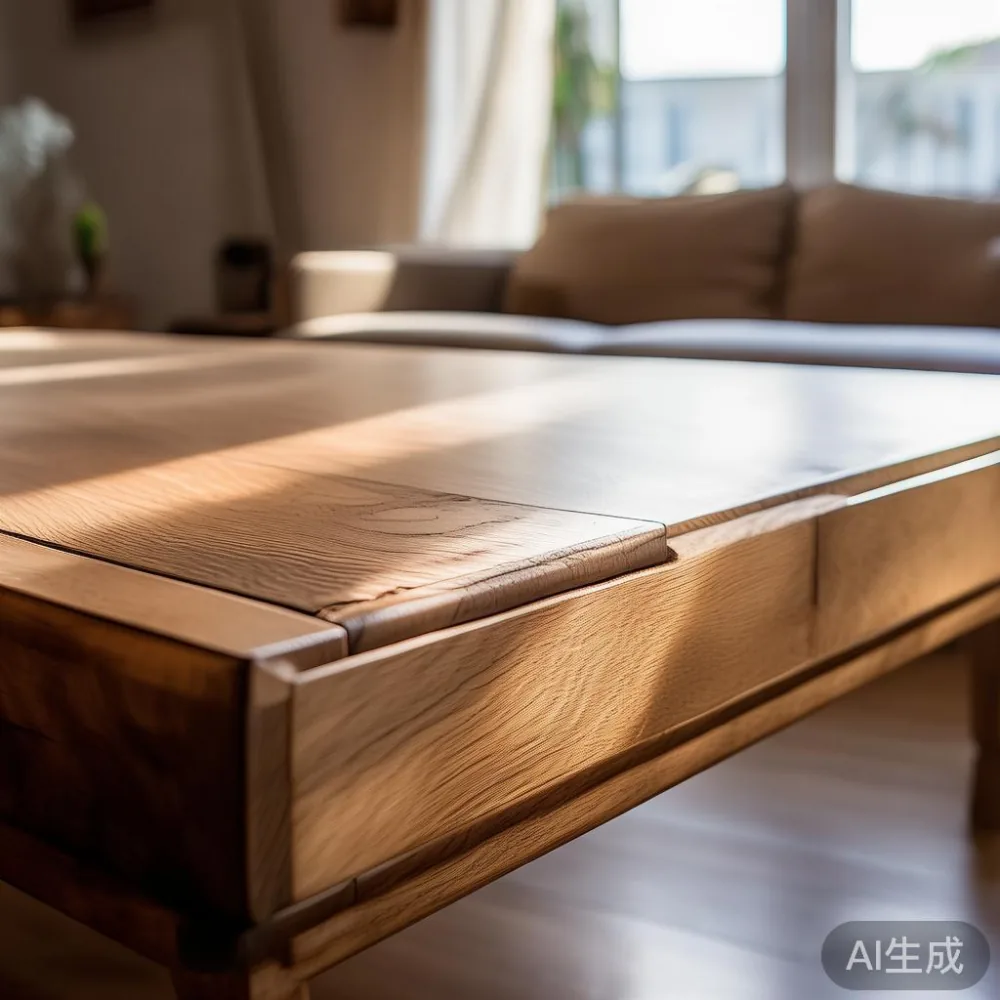
Solid wood becomes more financially interesting if the table remains in daily use and is maintained properly. A 25–30 mm oak top with a hardwax-oil finish can be sanded lightly and re-oiled, rather than replaced. A veneer table with a 0.6 mm face may show the engineered core if a deep scratch reaches through. A 1.2 mm veneer can tolerate more, but it still cannot be treated like a solid board.
This is why finish choice affects the 5-year result. A water-based lacquer on veneer may cost S$40–S$90 extra upfront and reduce the need for immediate care. A penetrating oil on solid wood may add S$50–S$120, yet permit local restoration later. The finish should be matched to how the table will be used, not selected only by its sheen.
Which construction handles Singapore humidity better?
Neither construction is completely immune to humidity. Singapore’s outdoor air can contain 70–90% relative humidity, while air-conditioned interiors may sit near 50–60%. Solid timber can expand and contract across its grain. Good joinery and a stable finish reduce visible movement, but a poorly made solid table can still twist.
Engineered panels are designed to reduce some dimensional movement, but they are not maintenance-free. Particleboard edges can swell if exposed to water, and repeated wetting around the sink-like coffee-table zone can soften the core. Veneer also has a grain direction that may reveal checking or small lifts along a joint if moisture changes rapidly.
Solid wood is usually easier to repair at the surface. Minor scuffs can be cleaned, lightly sanded and re-finished. Veneer can be patched only when the damage is small; a peeled corner may require replacement of the whole top. A Singapore household with children, pets or frequent guests may generate more than the assumed S$90 maintenance allowance on veneer.
I tested a sample comparison last month at MIDHILL’s showroom. I placed one oiled oak top and one lacquered veneer sample near a humid window for 14 days, wiped both with a damp cloth 3 times per week, and moved each across a tiled floor. The solid oak showed slight colour warming but no visible lifting. The veneer’s lacquer performed well, while a lower-cost edge band on the sample showed a small bubble after repeated moisture contact. That was a controlled test, not a guarantee, but it illustrates why edge sealing matters.
For a Bedok HDB flat, keep the coffee table 20–30 cm away from open windows and air-conditioning vents. Use a coaster under every cup and a felt pad under each foot. Wipe spills within 10 minutes. Those habits cost almost nothing and help both constructions age more predictably.
What if I need to replace the table during year five?
That question changes the comparison. If you expect to move homes or refresh the living room every 5 years, a new veneer table may be a practical choice. Suppose you replace it with another S$460 table, pay S$36.80 GST and S$60 delivery, then recover only S$80 for the old table. The additional turnover cost is about S$476.80 before maintenance.
A solid wood table may be worth keeping through several styling changes. If it retains S$450 resale value at year 5 and the replacement solid table costs S$790 plus S$63.20 GST and S$80 delivery, the net replacement cost is S$483.20. It then needs another S$60 maintenance allowance and S$70 repair-risk allowance, bringing the year-five reserve to roughly S$613.20.
This creates a near tie in the replacement scenario, even though the initial solid price was higher. If a second move happens in year 3 and the solid table is refinished rather than replaced, the economics can favour it. A professional touch-up may cost S$120–S$260, while a full refinishing service can cost S$280–S$450 depending on the table and finish.
For owners of a solid wood sofa, a solid wood bed frame, a dining table or a nightstand, matching the coffee table’s construction can create visual continuity. A wardrobe may be veneer while the coffee table is solid wood, provided the colour and sheen are controlled. A marble table has a different care profile altogether, so it should not be included in this wood-to-wood comparison.
Is solid wood worth paying S$330 more before GST?
For the buyer shown here, yes, if the table will be used daily, kept for at least 8–10 years and maintained rather than discarded. The extra S$330 before GST buys a repairable surface, a different tactile experience and more confidence around future refinishing. It does not guarantee that the table will last longer than every veneer model.
For a 3-year rental period, the answer can be no. A S$460 veneer table may meet the need, use less material and be easier for one person to carry. If the home has a 75 cm-wide lift door, a flat-packed design may be the deciding factor. A solid table may need to be carried by 2 people, adding S$30–S$60 to the delivery quote.
Style matters too. French light luxury often relies on pale oak, rounded profiles and visible material depth. A veneer table can suggest that look, but the edge and underside should be examined closely. American light luxury may use walnut-toned finishes and thicker-looking tops; a well-finished veneer can suit the style, although a solid top gives it more physical presence. Post-modern light luxury may combine slim legs, stone or lacquer with wood, so construction can be mixed without looking inconsistent.
For compact 90–105 cm HDB living rooms, a 100–120 cm table is usually more manageable than a 140 cm model. In a Tampines flat, leave 35–45 cm between the sofa and table edge where possible. In a condo, check whether the building allows oversized furniture during move-in periods, usually on designated dates rather than every day.
How should you read a coffee table sg price fairly?
Compare the delivered price, not the ticket price. Ask whether GST is included, whether stairs are included, and whether assembly is charged. Confirm the top thickness, core material, veneer thickness, finish type, leg material and warranty period. A table described simply as “wood” may be MDF with a printed surface, plywood with veneer, or solid hardwood.
Measure the lift before ordering. Record the door width, internal depth, cabin height and turning space. A 120 × 60 cm top that arrives as a flat pack may fit through an 80 cm opening, while a fully assembled 120 cm table may not. Delivery often takes 5–12 days in Singapore, but custom finishes can take 21–35 days. Add 2–3 days for access coordination in a managed condo.
Ask the supplier how scratches, water marks and edge damage are handled. A written structural warranty of 10 years is different from a warranty against every finish problem. MIDHILL, established in 2008 and exporting to more than 15 countries, applies a 10-year structural warranty on relevant products, offers lifetime refinishing under its stated policy, provides 14-day returns and ships free over US$350. Those terms should be read together with the specific product’s care instructions.
The exact phrase “is Japandi wardrobe worth it” belongs in a wardrobe discussion, not this comparison. The same care applies here: evaluate the coffee table as a separate object with its own dimensions, movement and finish. Do not let a broad style label hide weak joinery.
Which option gives the lower 5-year total?
For the model above, veneer has the lower 5-year total: about S$1,407.80 compared with S$1,863.20 for solid wood. The saving is approximately S$455.40, but it depends on maintenance, replacement timing and resale value. A more expensive solid table can cost less over time if it is retained, repaired and refinished.
A useful decision rule is simple. Choose veneer when the budget ceiling is firm, the table will be moved within 5 years, or access is difficult. Choose solid wood when the table will be used daily, the household values repairability and the furniture will remain in place for 8–10 years. If the budget is under S$1,200 delivered, a carefully made veneer design may provide the required proportions without stretching the account. If you are comparing under 2000 Modern light luxury furniture, compare materials and aftercare before focusing on the largest printed price.
Style-search phrases such as best American sofa for 2026 and best Boho bed for 2026 can guide a whole-room mood, but the coffee table still deserves its own inspection. Look for a stable top, clean underside, smooth edges, firm leg joints and a finish that can be maintained in a humid climate.
What would I buy for a Singapore home?
I would choose solid oak when the table is a daily-use centrepiece and the home has a reasonable access plan. I would choose veneer when speed, weight and initial cost matter more, but I would pay for a thicker 1.2 mm veneer, sealed edges and a durable water-based finish. I would not buy a vague low-price construction simply because the photograph looks pale.
Before ordering, take a tape measure to the intended lift, photograph the route and confirm the delivery window in writing. Keep the table 20–30 cm from persistent sunlight, use coasters and clean it with a lightly damp cloth. Those small actions can prevent the need for a complete replacement during the 60-month period.
Across 5 years, veneer can be the rational money choice, while solid wood can be the more useful long-term ownership choice. The right answer depends on your home, your hands-on maintenance and how long you want the table to remain. For most HDB and condo buyers who keep a home for several years, the difference is best understood as a trade between lower upfront cost and greater repair potential.